We’ve all been there: walking into a gym, seeing a sprawling sea of chrome, cables, and complex-looking machines, and feeling an immediate sense of "where do I even start?" The modern fitness world loves to sell us on complexity. We’re told we need 15 different variations of a bicep curl or a $3,000 smart-mirror to see results. But in our years of coaching and testing gear, we’ve found that the most impressive transformations don’t come from the flashiest tech. They come from mastering a small, dedicated list of Beginner Dumbbell Moves that target the entire body with surgical efficiency.
- •The Philosophy of a Minimalist Strength Routine
- •Mastering the Romanian Deadlift (RDL) for Posterior Power
- ◦Perfecting Your Hinge Technique
- •The Chest-Supported Row: Building a Resilient Upper Back
- ◦Why Support Matters for Beginners
- •The Goblet Squat: The King of Beginner Dumbbell Moves
- ◦Squatting for Longevity
- •The Dumbbell Bench Press: Balanced Pushing Power
- ◦Unilateral Benefits and Core Stability
- •Structuring Your Weekly Routine
- •Choosing the Right Gear
- ◦FAQ
- ◦How heavy should I start?
- ◦Can I do these moves every day?
- ◦What if I don't have a bench?
The beauty of the dumbbell is its honesty. Unlike a machine that dictates your path of motion, a dumbbell requires you to stabilize the weight yourself. This builds "real-world" strength—the kind that helps you lug a heavy suitcase through an airport or pick up a toddler without throwing out your back. Because each arm works independently, you also quickly identify and fix those sneaky strength imbalances where one side does all the heavy lifting.
If you’re looking to strip away the noise and focus on what actually moves the needle, you only need four foundational movements. By focusing on these, you aren't just "working out"; you're practicing the fundamental patterns of human movement. We’ve seen hundreds of clients move from "total novice" to "confident lifter" just by sticking to these basics for twelve weeks.
The Philosophy of a Minimalist Strength Routine
We often see people fall into the trap of "gym-hopping"—trying a new influencer’s workout every Tuesday and wondering why their weights never go up. The secret to actual muscle growth and fat loss isn't variety; it's consistency and progressive overload. When you limit your selection of Beginner Dumbbell Moves, you give your nervous system a chance to actually learn the skill of lifting.
In our experience, a structured approach beats a randomized one every time. By sticking to a core group of exercises, you can track exactly how much weight you’re moving. If you did 20-pound RDLs last week and 25-pound RDLs this week, you have objective proof that you’re getting stronger. That’s a massive psychological win that keeps you coming back.
Mastering the Romanian Deadlift (RDL) for Posterior Power
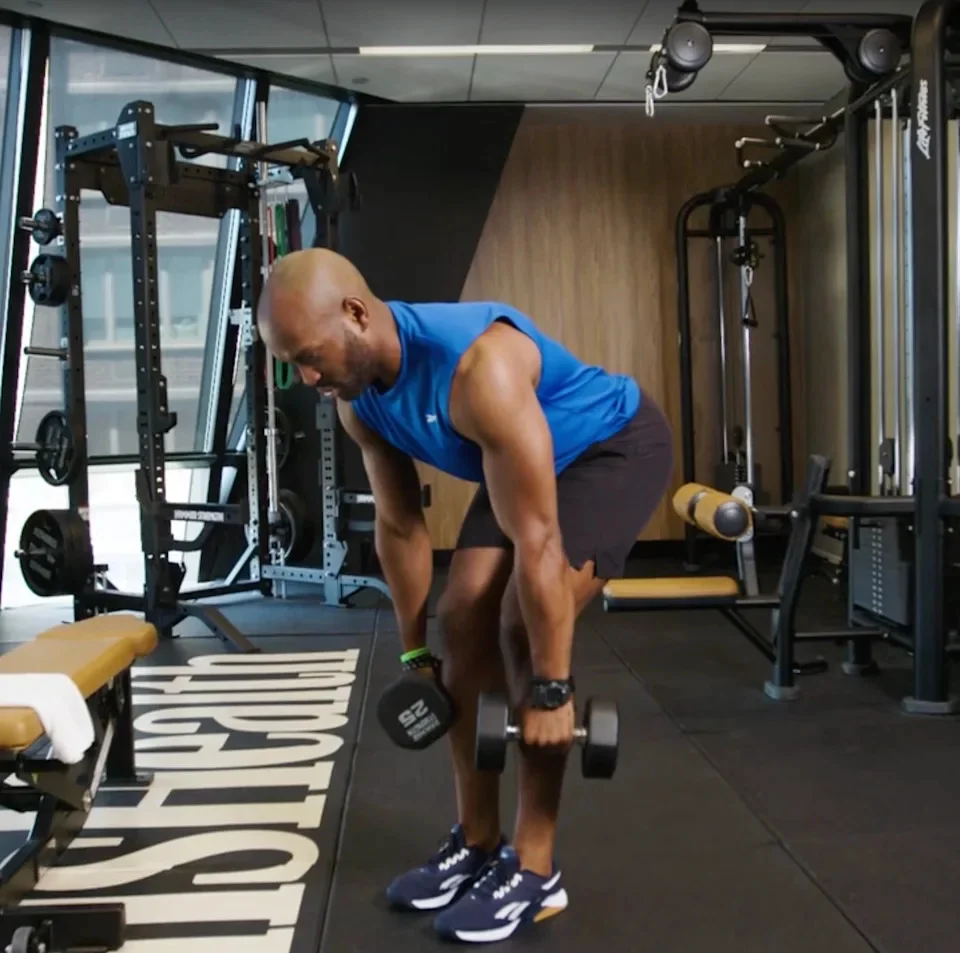
The Romanian Deadlift, or RDL, is arguably the most important "hinge" movement you can learn. While a standard squat is knee-dominant, the RDL is all about the hips. We find that many beginners struggle with this because they try to reach for the floor with their hands rather than pushing their hips back.
To do this right, stand with your feet hip-width apart and hold the dumbbells against your thighs. Think about "shaving" your legs with the weights as you descend. The goal isn't to touch your toes; it's to push your glutes toward the wall behind you until you feel a deep stretch in your hamstrings. This movement is the ultimate fix for weak glutes beginner trail runner injury link issues, as it forces the entire back side of your body to wake up and work.
Perfecting Your Hinge Technique
One of the most common errors we see is "rounding the lighthouse." This happens when a lifter lets their shoulders slump forward, putting all the stress on the lower back. To fix this, imagine you’re trying to squeeze a pair of oranges in your armpits. This engages your lats and keeps your spine locked in a safe, neutral position.
If you find your grip failing before your legs do, don't be afraid to use a slightly lighter weight and focus on a "3-0-1" tempo. That means taking three seconds to lower the weight, no pause at the bottom, and one second to snap back up to a standing position. This increased time-under-tension is where the magic happens for muscle fiber recruitment.
The Chest-Supported Row: Building a Resilient Upper Back
Most people spend their days hunched over a laptop or a steering wheel, which leads to "gamer posture"—rounded shoulders and a weak upper back. The chest-supported row is our favorite antidote for this. By leaning your chest against an incline bench, you remove the temptation to "cheat" the movement by swinging your torso.
We suggest setting your bench to about a 45-degree angle. Let your arms hang straight down, then pull the dumbbells toward your hips, not your armpits. Driving the elbows back helps you engage the rhomboids and traps rather than just overworking your biceps. It’s a subtle shift, but it’s the difference between a "meh" workout and one that actually improves your posture and shoulder health.
Why Support Matters for Beginners
We often find cases where beginners try to do standing bent-over rows and end up with a nagging ache in their lower back. This usually isn't because their back is "weak," but because their core isn't yet conditioned to hold that bent-over position while the arms are moving. Using the bench as a "kickstand" for your torso allows you to focus 100% on the pulling muscles.
For an extra challenge, try a "stop-and-squeeze" at the top of the movement. Hold the dumbbells against your ribs for a full two-count before slowly lowering them back down. This builds incredible mind-muscle connection, which is a fancy way of saying you’re teaching your brain how to actually find and use those back muscles.
The Goblet Squat: The King of Beginner Dumbbell Moves
If we could only pick one lower-body exercise for the rest of our lives, it would be the goblet squat. Holding a single dumbbell against your chest like a "goblet" acts as a natural counterbalance. This allows you to sit deeper into the squat with a more upright torso than you ever could with a barbell on your back.
For the setup, cup the top head of the dumbbell in both hands and keep your elbows tucked in. As you squat down, your elbows should track inside your knees. This "elbows-to-knees" cue is a great way to ensure you're getting enough depth. If you're a runner, this move is a powerhouse for strength training beginner trail runner injury prevention because it builds the quad and glute stability needed for uneven terrain.
Squatting for Longevity
A common troubleshooting error we see is the "heels-up" squat. If your heels are lifting off the floor as you go down, it’s usually a sign of tight ankles. A quick fix? Place a pair of small 2.5lb plates under your heels. This slight elevation changes the geometry of the lift and allows you to stay upright.
But don't rely on the plates forever. We recommend pairing your goblet squats with basic ankle mobility drills. The goal is to eventually be able to "sit" in the bottom of the squat comfortably. This move isn't just about building big legs; it's about maintaining the ability to move through a full range of motion as you age.
The Dumbbell Bench Press: Balanced Pushing Power
The bench press is the classic "bro" move, but doing it with dumbbells is actually much safer for your shoulders. A barbell locks your hands into a fixed position, which can cause impingement for some people. Dumbbells allow your wrists and elbows to move through a more natural, slightly arched path.
When you lie back on the bench, don't just flop down. Plant your feet firmly on the floor and squeeze your shoulder blades together. This creates a stable "platform" for you to press from. As you lower the weights, aim for your elbows to be at about a 45-degree angle from your body. If they’re flared out like the letter "T," you’re putting unnecessary stress on the delicate rotator cuff muscles.
Unilateral Benefits and Core Stability
One of the coolest things about using dumbbells for the bench press is the ability to swap to a single-arm press. We often have our clients do this to test their core stability. If you try to press a heavy dumbbell with just your right arm while lying on a bench, your entire core has to fire to keep you from rolling off the side.
Even in the standard two-arm version, you’ll notice that one arm might want to go faster than the other. That’s your body’s way of revealing a weakness. Don't rush it. Match the speed of your strong side to your weaker side. Over time, those Beginner Dumbbell Moves will even you out, making you a more symmetrical and injury-resistant athlete. Consistency is key when performing these moves for growth.
Structuring Your Weekly Routine
Knowing the moves is only half the battle; knowing how to arrange them is where the progress happens. For most beginners, we recommend a three-day-a-week full-body split. This gives your muscles 48 hours to recover between sessions, which is when the actual growth occurs.
| Exercise | Sets | Reps | Rest |
|---|---|---|---|
| Goblet Squat | 3 | 10-12 | 90 sec |
| Chest-Supported Row | 3 | 10-12 | 60 sec |
| Romanian Deadlift | 3 | 8-10 | 90 sec |
| Dumbbell Bench Press | 3 | 8-10 | 60 sec |
This simple table covers all your bases. You’re hitting a "knee-dominant" move, a "pull," a "hinge," and a "push." If you do this consistently, you’ll be doing more for your physique than 90% of the people doing random circuits on Instagram.
Choosing the Right Gear
We are often asked about the best equipment for a home setup. If you have the space, a set of "Hex" dumbbells (the ones with the rubber six-sided heads) are the gold standard. They don't roll away, and they’re incredibly durable. However, if you’re in a small apartment, a pair of high-quality adjustable dumbbells like the PowerBlock or the Nuobell are worth the investment.
Practical tips from our team: always buy a bench that feels "sticky." There is nothing worse than trying to do a chest-supported row and sliding down the vinyl because you’re sweating. Look for a bench with a high-density foam pad and a weight capacity that accounts for both you and the dumbbells you’ll eventually be lifting.
FAQ
How heavy should I start?
We usually suggest starting with a weight that feels like a "6 out of 10" in terms of difficulty. You should be able to complete all your reps with perfect form, but feel like you could only do maybe two or three more if you absolutely had to. For most men, this is 15-25lb dumbbells; for women, 10-15lb is a common starting point.
Can I do these moves every day?
We wouldn't recommend it. Muscles don't grow while you're lifting; they grow while you're sleeping and resting. If you hit the same muscle groups every single day, you'll eventually hit a wall of fatigue and potentially risk an overuse injury. Stick to 3-4 days a week.
What if I don't have a bench?
You can get creative! For the chest-supported row, you can do a "one-arm bent-over row" by supporting yourself on the back of a sturdy couch or a kitchen counter. For the bench press, you can do a "floor press" by lying on a rug. It limits your range of motion slightly, but it's still a very effective way to build chest and tricep strength.
Starting a strength journey is one of the best decisions you can make for your long-term health. It’s not just about the mirror; it’s about the confidence that comes from knowing you are physically capable. By mastering these four Beginner Dumbbell Moves, you are building a foundation that will serve you for decades. Don't worry about the fancy machines or the latest trends. Pick up the weights, focus on the feel of the movement, and trust the process. The results will follow.


