
Maintaining a high cadence and a slight forward lean directly reduces the heavy impact of downhill running beginner trail injuries by shifting the pounding from your joints to your muscles. Running downhill subjects your legs to intense eccentric contractions that absorb up to five times your body weight per stride. For newcomers, these forces can easily lead to debilitating muscle soreness, shin splints, or severe knee irritation if the descent is handled incorrectly. Adjusting your posture and taking shorter, quicker steps allows your body to safely absorb this massive gravity-fed load, effectively preserving long-term joint health.
- •Understanding the Immediate Physical Impact of Downhill Running
- ◦The Kinetic Chain and the Impact of Downhill Running on Joints
- •The Broader Ripple Effect: Beyond Immediate Pain
- •The Role of Technique and Preparation in Mitigating Injury
- •The Psychological Toll: Eroding Confidence and Enjoyment
- •Long-Term Consequences and Future Participation
- •The Learning Curve and the Danger of Overconfidence
- •FAQ: Addressing Common Concerns About Downhill Running
Transitioning from flat, predictable pavement to technical off-road descents requires specific physical adaptation rather than just raw grit. In fact, the steepest learning curve for most mountain athletes isn't the climb itself, but the intense strain of the return journey. Failing to master proper downhill technique often results in quick burnout or sudden ankle sprains that sideline new runners for weeks. By focusing on smart body positioning and giving your muscles adequate time to adapt to downhill forces, you will build a resilient foundation that ensures your trail running journey remains safe, active, and highly enjoyable.
Understanding the Immediate Physical Impact of Downhill Running
When a runner first transitions to the trails, the descent often feels like "free speed." It’s tempting to open up the stride and let gravity do the work. However, the physical toll of this decision is immediate and significant. The primary mechanism at play is eccentric loading. Unlike flat ground running, where muscles primarily shorten to create movement, downhill running forces your muscles—specifically the quadriceps and calves—to lengthen while under extreme tension. This act of "braking" creates microscopic tears in the muscle fibers. We often see beginners who can run a road half-marathon with ease suddenly find themselves unable to walk down a flight of stairs two days after a modest beginner trail session. This isn't just standard fatigue; it’s a specific physiological response to the impact of downhill running.
The quadriceps act as the body's primary shock absorbers. In our observations, runners who "heel strike" heavily on descents increase the load on their patellofemoral joint exponentially. This repetitive pounding can lead to acute inflammation. While road running is repetitive, trail running is chaotic. Every step requires the stabilizing muscles around the ankle and knee to fire in a fraction of a second to compensate for shifting rocks or slippery roots. For a newcomer, these stabilizers are often the first point of failure. When the muscles fatigue, the stress shifts directly to the ligaments and tendons, which are far less capable of absorbing the high-velocity impact of a descent.
The impact of downhill running also extends to the skeletal system. The vertical oscillation—the "bounce" in your step—is much higher when moving downhill. This increases the ground reaction force. Without proper footwear or technique, this force travels up the kinetic chain, affecting the shins, knees, and even the lower back. We’ve seen many cases where what was thought to be a simple case of "sore legs" was actually the beginning of a stress reaction in the tibia, caused by the relentless hammering of downhill sections on hard-packed dirt or rock.
The Kinetic Chain and the Impact of Downhill Running on Joints
The human body functions as a single unit, and nowhere is this more evident than on a technical descent. When your foot hits the ground on a 15% grade, the force doesn't stop at the ankle. It travels through the sub-talar joint, up the tibia, into the knee, through the femur, and into the hip and spine. If any link in this chain is weak or misaligned, the impact of downhill running will find and exploit that weakness. For many, this manifests as "Runner’s Knee," where the kneecap doesn't track properly because the hips are too weak to stabilize the leg during the high-force landing phase.
We often recommend that runners pay close attention to their "braking" distance. If you are reaching your foot out far in front of your body to slow down, you are essentially hitting the "stop" button with every stride. This creates a jarring force that the joints must dissipate. Instead, a shorter, quicker stride allows the muscles to catch the weight more fluidly. In our experience, shifting to a cadence of 170-180 steps per minute, even on steep sections, can reduce the peak impact force on the knee by a substantial margin, protecting the cartilage and long-term joint health.
Ankle stability is another critical factor. The lateral impact of downhill running on uneven terrain is a major cause of ligamentous damage. A trail running shoe with a lower stack height can often provide better "ground feel," allowing the brain to react faster to a rolling stone. When the brain receives faster feedback from the nerves in the feet, it can engage the peroneal muscles more quickly, potentially turning a "run-ending" ankle roll into a minor stumble. This neuromuscular connection is a skill that must be developed just as much as cardiovascular fitness.
The Broader Ripple Effect: Beyond Immediate Pain
The impact of downhill running isn't confined to the duration of the run or the immediate recovery period. There is a psychological and financial ripple effect that can derail a runner’s progress. For a beginner, the excitement of a new hobby is often tied to a sense of rapid improvement. An injury sustained on a descent—whether it’s a twisted ankle or a case of severe patellar tendonitis—acts as a sudden and demoralizing halt. This "stop-start" cycle is one of the primary reasons people abandon the trails within their first six months.
Psychologically, an injury creates a "fear-avoidance" loop. We’ve observed that once a runner has a bad fall, they tend to become overly cautious on future descents. They lean back, stiffen their legs, and dig their heels in. Ironically, this defensive posture actually increases the impact of downhill running by removing the body’s natural spring-like mechanics. The result is more pain, which reinforces the fear, creating a cycle that robs the sport of its joy. Breaking this cycle requires a deliberate focus on rebuilding confidence through low-stakes practice on gentle slopes.
Financially, the costs can escalate quickly. While running is often marketed as a "free" sport, a significant injury changes that equation. Physical therapy sessions, specialized imaging like MRIs, and high-end recovery tools like compression boots or professional massages become necessary expenses. For a beginner who hasn't yet fully committed to the lifestyle, these costs can feel like a barrier to entry. We’ve seen many talented runners return to the treadmill simply because the "maintenance cost" of trail-related injuries became too high for their budget.
The impact on consistency is perhaps the most damaging long-term effect. Fitness is built on the back of months and years of steady work. Every time a descent-related injury forces a three-week hiatus, the runner loses not just their aerobic base, but also the structural adaptations they’ve worked so hard to gain. This makes the eventual return to running even riskier, as the muscles may have weakened while the runner still tries to maintain their previous pace. It’s a recipe for a recurring injury cycle that can turn a passionate hobby into a source of chronic frustration.
To help visualize the difference in demands, consider this comparison of running styles:
| Factor | Uphill Running | Downhill Running |
|---|---|---|
| Primary Muscle Action | Concentric (Shortening) | Eccentric (Lengthening) |
| Impact Force | Low (less vertical drop) | High (up to 5x body weight) |
| Cardiovascular Strain | Very High | Moderate to Low |
| Injury Risk Profile | Strain/Overuse | Acute/Impact/Trauma |
The Role of Technique and Preparation in Mitigating Injury
Mastering the impact of downhill running requires a combination of specific strength training and technical proficiency. Most road runners have "weak" eccentric strength because they rarely train for it. To prepare the body for the trails, we often recommend "eccentric-focused" exercises. Movements like slow-tempo Bulgarian split squats or eccentric step-downs (where you take 3-5 seconds to lower yourself) mimic the demands of a descent. By pre-conditioning the muscles in a controlled environment, you prepare them for the chaotic forces of the trail.
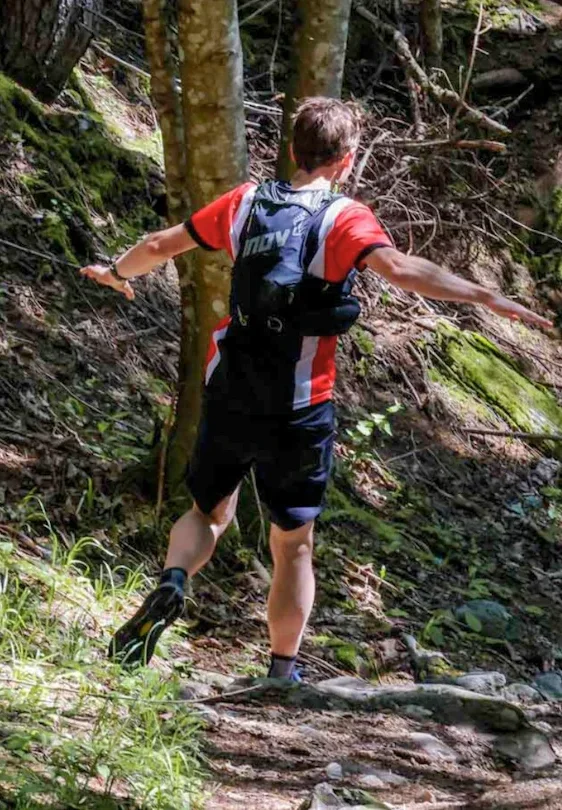
Technique is the other half of the equation. Many beginners make the mistake of leaning backward, away from the slope. This is a natural "survival" instinct, but it’s counterproductive. Leaning back puts your center of gravity behind your feet, making you more likely to slip and increasing the braking force on your knees. Instead, we teach runners to lean slightly forward from the ankles, keeping their feet underneath their hips. This "nose over toes" approach allows for a more fluid, rolling gait that dissipates the impact of downhill running more efficiently.
Foot placement is also a skill that can be trained. Experienced runners use "micro-steps" to navigate technical sections. Rather than taking one big leap off a rock—which results in a massive impact—they might take three quick, light steps. This distributes the force across multiple foot strikes and gives the runner more opportunities to adjust their balance. It’s about being "light on your feet," a phrase that carries heavy weight when you’re descending 2,000 feet of vertical gain. We suggest practicing these quick feet on a flat, soft surface like a grass field before taking them to a rocky descent.
Core stability shouldn't be overlooked. Your core is the anchor that keeps your upper body stable while your legs are dancing over obstacles. If your trunk is flailing, your legs have to work twice as hard to maintain balance. A strong core allows for better "proprioception"—the body’s ability to sense its position in space. This is vital for managing the impact of downhill running, as it allows for near-instantaneous corrections when you step on a loose stone or a patch of mud. For more on the fundamentals of movement, checking out impact downhill running resources can provide a solid baseline for gear and form.
The Psychological Toll: Eroding Confidence and Enjoyment
The mental aspect of the impact of downhill running is often the most difficult to heal. Unlike a muscle tear, which has a clear recovery timeline, a loss of confidence can linger for years. We’ve worked with runners who, despite being physically healed, still experience a spike in heart rate and a tightening of the muscles as soon as the trail points downward. This tension is the enemy of good form. When you are tense, your joints are "locked," and they cannot act as the natural springs they are meant to be.
This erosion of enjoyment is a tragedy in a sport that is supposed to be about freedom and exploration. Trail running offers a unique "flow state" that is hard to find elsewhere, but that flow is impossible to achieve if you are constantly bracing for pain. We’ve seen beginners start to avoid certain routes or skip group runs because they are embarrassed by their slow pace on the descents. This social isolation further compounds the psychological impact, making the runner feel like an outsider in their own community.
To combat this, we recommend "exposure therapy" for the trails. Start with very short, very gentle descents on a surface you trust, like a well-groomed fire road. Focus entirely on the sensation of being relaxed. Keep your jaw loose, your shoulders down, and your breath steady. As your confidence grows, you can gradually increase the technicality and the grade. The goal is to reprogram the brain to see the descent not as a threat, but as a skill to be mastered. Over time, the impact of downhill running becomes something you manage proactively rather than something you suffer through.
Long-Term Consequences and Future Participation
If left unaddressed, the impact of downhill running can lead to chronic issues that extend well beyond the trails. We’ve seen cases of chronic ankle instability where a runner has rolled their ankle so many times that the ligaments are permanently stretched. This doesn't just affect running; it affects daily life, making the individual more prone to falls in any environment. Similarly, chronic patellar tendonitis can make simple tasks like walking down stairs or sitting for long periods uncomfortable.
There is also the risk of "compensatory injuries." When a runner has a nagging pain in their right knee from a bad descent, they naturally shift more weight to their left side. Over hundreds of miles, this imbalance can lead to a hip injury on the left side or a stress fracture in the left foot. The body is an expert at compensation, but those shortcuts eventually come due. This is why it’s so important for beginners to address the impact of downhill running early, rather than trying to "run through" the pain. Seeking professional guidance from a physical therapist who understands the specific demands of trail running is often the best investment a runner can make.
The ultimate long-term consequence is the loss of the sport itself. We’ve met many former trail runners who now only walk or swim because they "blew out their knees" in their first year of running. In many cases, these injuries were preventable with better technique and a slower progression. It’s a sobering reminder that while the trails are beautiful, they are also unforgiving. Respecting the impact of downhill running is the key to longevity. It’s not about how fast you can go down the mountain today, but whether you’ll still be able to run down it twenty years from now.
The Learning Curve and the Danger of Overconfidence
A common friction point we see in the clinic is the "fit road runner" trap. These are individuals with high cardiovascular engines who can maintain a 7-minute mile on the road for hours. When they hit the trails, their lungs feel great, so they assume their legs can handle a fast descent. They lack the "trail legs"—the specific connective tissue strength and neuromuscular coordination—required to handle the impact of downhill running at high speeds. This mismatch between aerobic fitness and structural readiness is a recipe for disaster.

Overconfidence often leads to poor gear choices as well. A road shoe lacks the traction and protection needed for a technical descent. Without the proper "lugs" on the outsole, a runner is more likely to slip, leading to a sudden, high-force impact as they try to catch themselves. We always suggest that beginners invest in a trail-specific shoe with a rock plate and a secure heel lockdown. This small change can significantly reduce the mechanical impact of downhill running by providing a stable platform for every foot strike.
Reading the trail is another skill that only comes with time. An experienced runner can see a patch of "dark" dirt and know it’s likely mud, or see a certain type of rock and know it’s slippery when wet. Beginners often miss these subtle cues, leading to unexpected slips and falls. This "environmental literacy" is a crucial part of managing the impact of downhill running. It allows you to choose the line of least resistance, avoiding the high-impact drops and choosing the softer landings whenever possible. It’s a game of chess played at 10 miles per hour.
FAQ: Addressing Common Concerns About Downhill Running
What is the most effective way to reduce the impact of downhill running on my knees?
The most effective strategy is to increase your cadence. By taking shorter, more frequent steps, you reduce the time your body spends in the air and the subsequent force of the landing. Maintaining a slight forward lean ensures that your muscles, rather than your joint cartilage, absorb the bulk of the energy.
Should I use trekking poles to help with descents?
Yes, we often recommend trekking poles for beginners or those recovering from injury. Poles act like two extra legs, allowing you to offload a significant portion of your body weight. Research has shown that using poles on descents can reduce the impact of downhill running on the lower extremities by up to 25%, making them a valuable tool for long days in the mountains.
How do I know if my soreness is "normal" or a sign of injury?
Standard muscle soreness (DOMS) usually peaks 24–48 hours after a run and is felt in the "meat" of the muscle. If you experience sharp pain, swelling, or pain that is localized to a joint or a bone, that is a red flag. If the pain doesn't improve with rest or makes you alter your walking gait, it’s time to see a professional to assess the impact of downhill running on your structural health.
Does the type of terrain change the impact?
Absolutely. Hard-packed fire roads or rock slabs provide very little "give," meaning your body has to absorb all the force. Softer surfaces like pine needles, loam, or even loose scree can act as a natural cushion. However, softer surfaces often require more stability. We suggest beginners start on moderate, "buffed out" trails to allow their bodies to adapt to the impact of downhill running before moving to more technical terrain.
Maintaining a high cadence, a slight forward lean, and incorporating eccentric strength training are the best ways to reduce the impact of downhill running beginner trail injuries. When you face a steep decline, the natural instinct is to lean back and brake with your heels, but this kooky posture sends a jarring shockwave straight through your ankles, knees, and hips. Downhill running forces your muscles to lengthen under heavy tension, absorbing up to five times your body weight per stride. For anyone just starting out, this intense eccentric load can easily cause severe muscle soreness and joint inflammation if you try to fight against gravity instead of working with it.
To safely master these technical descents without destroying your knees, you need to actively build a biological "brake" through targeted weekly training. Incorporating slow-tempo squats, lunges, and eccentric step-downs into your routine will fortify your quadriceps and patellar tendons, preparing them for the brutal pounding of the return journey. On the trail, focus on taking shorter, faster steps—often called the "patter" technique—to minimize your time in the air and allow for quick footwork adjustments over loose rocks and hidden roots.
Managing the mental side of descending is just as critical for long-term safety, as fear typically causes your body to stiffen up and become far more prone to sudden injuries. Practice keeping a relaxed, "soft" gaze focused several meters ahead rather than staring directly down at your toes, which allows your brain to subconsciously map out the safest path. Finally, respect the recovery process by avoiding back-to-back high-impact days, since eccentric muscle damage usually peaks 24 to 48 hours later. By combining these smart strength habits with a patient approach to progression, you can confidently fly down mountain trails while protecting your joints for years to come.